
We are living in an AI era where we cannot ignore the use cases of AI models like ChatGPT, Claude, and many more. To be honest, we need them daily in our day-to-day life; to be precise, in our work life. If you are a coder, you don’t need to build an entire feature; just start and feed the code or idea into the model, and it will give you an overview or even complete it beyond your expectations. It is useful in most cases, and we can’t ignore it anymore.
Earlier, we were not able to ignore search engines like Google. For every query, we needed to search Google and get answers from indexed pages where someone had posted a solution to a problem on their blog or website. We would go there and find our answer. Similarly, we have evolved into using AI models for everything, starting from grocery product checklists, checking small grammar errors, email writing, code generation, and even checking our health problems. These models have most of our data, like 90 percent of our personal information: what we like, what we do in our free time, our political views, who we support, and even our medical data, because all of this has been shared with AI models.
The scariest part is: what if this data is sold in the name of ads, like big social media companies such as Meta do? AI companies have started the process of introducing ads into AI models.
For example, Open AI announced last month in their press release that they will introduce ads into their models for free users and low-tier subscribers, while Pro subscribers will remain ad-free. For free users as well, they have said that ads will not disturb their workflow or the environment while using the models.
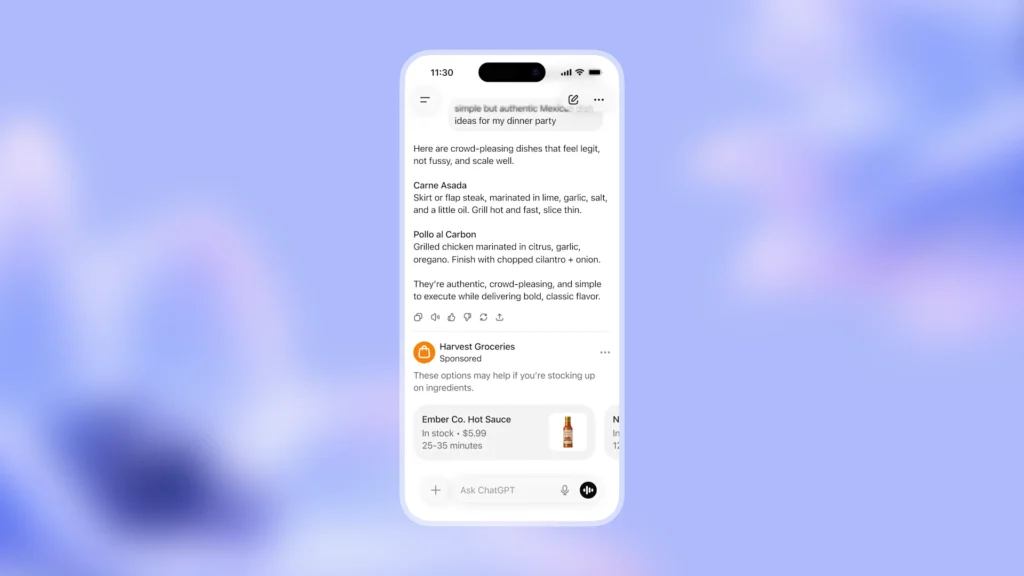
Open AI has clearly stated that they will not use user data to show personalized ads. However, they have mentioned that they will use the current conversation to show ads through contextual targeting, as shown in the image added below, which was from ChatGPT. In the example, it was clear that the user was asking for dishes for a party they were organizing, and the model suggested adding a hot sauce to the list. This may not be one hundred percent accurate, but it could be a way to initially make users feel that ad targeting is not very precise.
Over time, they may gradually move toward more fluent targeting, which is what most companies do. The question will arise: what we can do to prevent ourselves from this? Is there any way to be open? There is no road ahead, because nowadays AI models are essential, and we can’t ignore them. The only thing we can do is use it very cautiously. Don’t share any personal information with models, like your bank information, your health data, and finance data as well. If you don’t have any options, consider using it on a temporary chat. On that as well, strictly don’t ask anything about your health data. And also turn off personalized ads from the settings as well.
At least from this, we can say that for the time being we can stay away from targeted advertising.
